
12 October 2026
How AI concretely helps a small business
Four jobs an AI agent takes over in a small business today: sorting and answering email, preparing quotes, searching your own documents and moving data between systems. Where to start, what drives the cost, and what AI must not do.
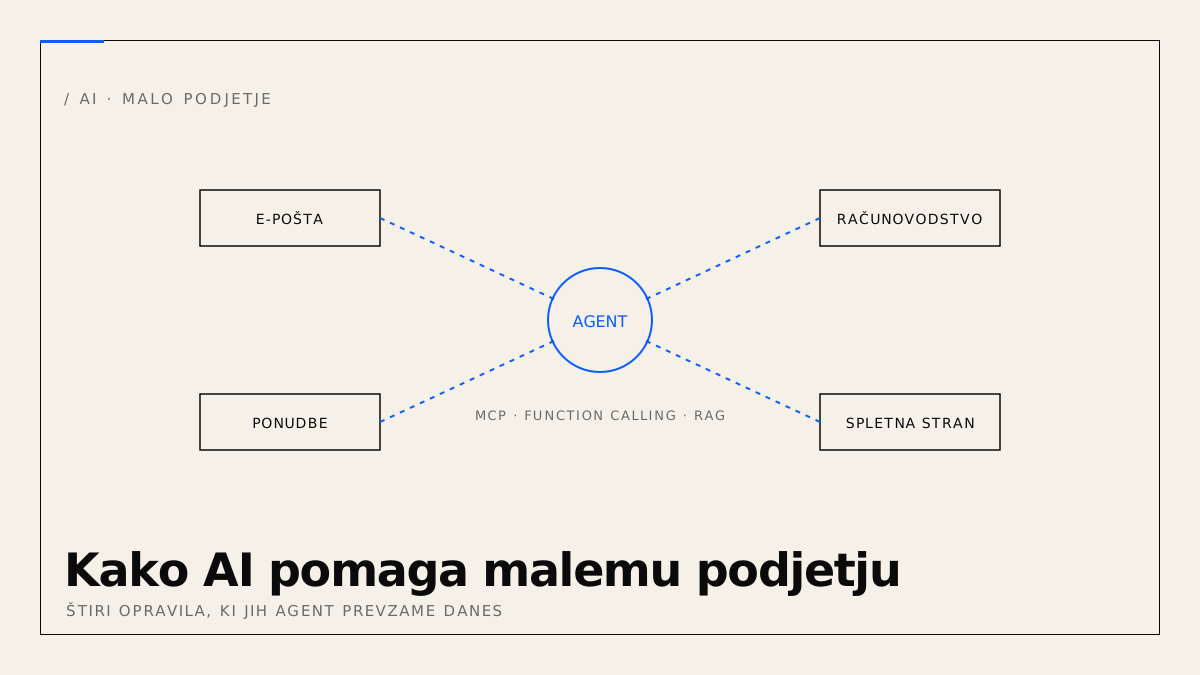
Most writing about AI for business talks about strategy. A small business needs an answer to a different question: which job that a person does today can an agent take over tomorrow, and what has to happen for that. Below are four jobs we implement in practice, and answers to the questions that come up along the way.
How does AI concretely help a small business?
By taking over repetitive jobs that involve reading and writing text, and doing them inside the systems the business already uses. The four that most often pay off:
1. Sorting and answering email
The agent reads every incoming message, labels it (inquiry, complaint, invoice, spam), drafts a reply to routine questions from your own data and sends it for review. A person approves or corrects rather than writing from scratch. For a business that gets 30 messages a day, that means someone reads for half an hour instead of two.
2. Preparing quotes
The agent extracts what the customer needs from the inquiry, finds the matching items in your price list and assembles a draft quote in your template. The model does not calculate prices; they come from the price list or from deterministic code. Why that matters is explained in how to generate quotes with an AI agent, and the concrete architecture is in the case study.
3. Searching your own documents
Contracts, manuals, past quotes, technical documentation. Using RAG (retrieval-augmented generation), the agent answers questions from those documents and cites which document the answer came from. A new colleague asks "what is our complaints procedure" instead of searching folders for three days or interrupting a colleague.
4. Moving data between systems
An order arrives by email, someone retypes it into the accounting software, then into the production spreadsheet. The agent reads the order and writes it into both systems through MCP (Model Context Protocol), and a person checks. What MCP is and how to connect it to your tools is covered separately.
Where should a small business start with AI?
With one job that meets three conditions: it repeats every day, it has a clear input and output, and a mistake is cheap because a person reviews it before it takes effect. Email and draft quotes meet those. Automatically sending invoices to customers does not, because a mistake is expensive.
The first step is not buying a tool but taking inventory: which jobs, who does them, how long they take, which systems the data comes from. That inventory takes two hours, shows where the biggest saving is, and is also the content of the AI integration project brief.
What determines the cost of introducing AI?
Four things, none of them the model. How many systems need connecting and whether they have an API. How many documents or records need preparing for search. Whether the agent only suggests or also performs actions (the second needs more safeguards). And how many people will use it, which drives the running cost of model calls. For a small business the model itself is usually the smallest line item.
What must AI in a business not do?
Decide on prices, discounts and terms, because models calculate unreliably and carry no responsibility. Send messages to customers without human review, at least in the first months. Process personal data without a data processing agreement with the model provider and without an entry in the processing register. The most common mistakes in adoption, including agents with permissions that are too broad, are collected in pitfalls of introducing AI agents.
What does this mean for your website?
The site you are reading has its own MCP server, through which an AI agent can read the services and submit an inquiry on your behalf. A growing share of visits comes from agents rather than people, and a site that gives agents structured data instead of HTML to guess from has the advantage in that kind of search.
If you have one job that meets the three conditions above, describe it in the AI integration project brief. Seven steps, about 10 minutes, and a scope proposal within one business day. If you are not sure which job is the right one, that is the first question we answer together.