
12 August 2026
What determines the price of a website?
Five factors set the price of a website: features, content, scope, integrations and maintenance. None of them is the technology. A breakdown of what moves the price up or down in each, and why we do not publish a price list.
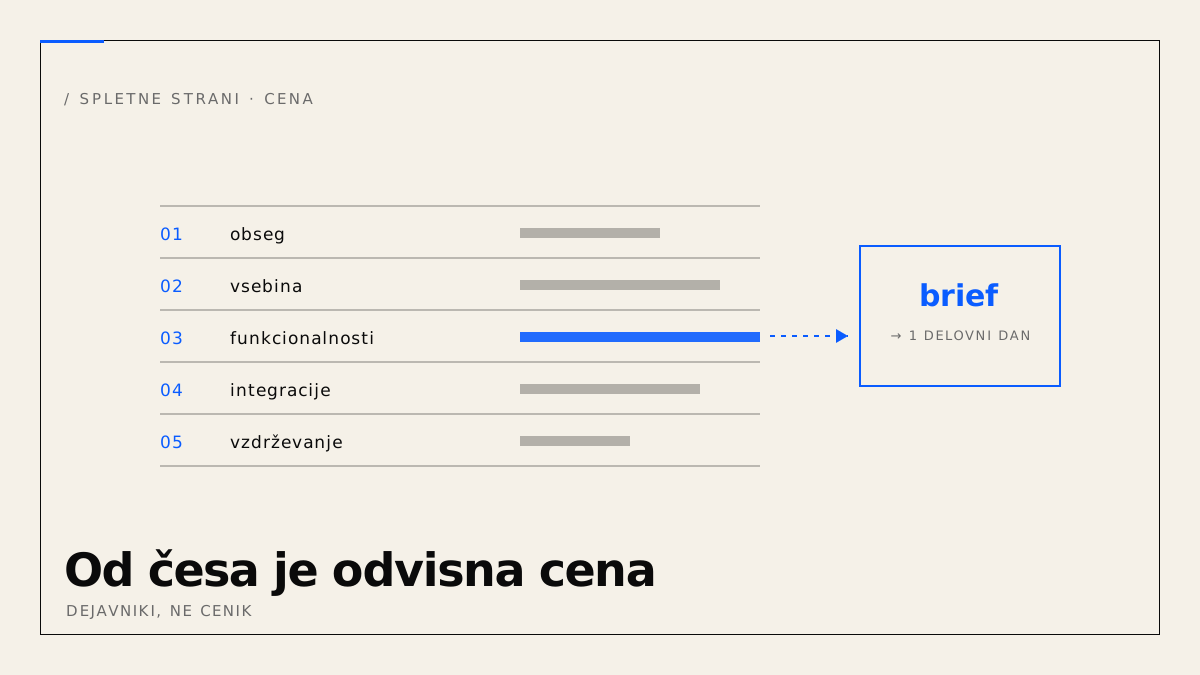
The price of a website depends on five factors that you decide: how many pages, who prepares the content, what the site has to do, what it connects to, and who takes care of it after launch. The technology follows from those answers. Each factor is broken down below so you can judge which class your project falls into. No numbers, because any number without a scope would mislead.
What determines the price of a website?
Five things, in order of impact: features, content, scope, integrations and maintenance. Design, which clients usually put first, is in practice a smaller factor than content. A beautiful site without copy and photos cannot be published.
1. Features: what the site has to do
The biggest lever. A presentation site that shows services and has a contact form is one class. Each of the following opens a new class:
- user login and protected content,
- bookings, orders or payments,
- search and filtering over a larger catalogue,
- multiple languages (each language is a translation of the content and a layout check),
- editing your own content through an admin,
- an AI assistant or a connection to agents.
Rule of thumb: if the site has to accept, store or calculate something rather than only display it, you are looking at a web application, not a website. That is a separate service, web applications.
2. Content: who writes the copy and prepares the images
The second biggest lever and the most often overlooked. Three options, from cheapest to most expensive:
- You deliver the content: copy, photos, a vector logo, company data. The provider only builds.
- We prepare the content together: you deliver raw material, we structure, shorten and write the headlines.
- We prepare the content: interview, writing, photography or photo selection, translation.
Projects that run late almost always run late because of content, not development. If you have the copy ready before the start, you have saved more than on any other factor.
3. Scope: how many pages and how many templates
The number of pages matters less than people think. What matters is the number of distinct templates. Home page, service page, news post, contact: that is four templates. Thirty news posts on the same template do not cost thirty times more. Ten pages that are each different mean ten templates.
4. Integrations: what the site connects to
Every connection to an external system is a separate piece of work with its own risk:
- a CRM or email system (where inquiries go),
- accounting or ERP (products, stock, prices),
- a payment provider,
- a calendar or booking system,
- analytics that has to be GDPR-compliant without cookies.
An integration where the external system has a documented API is predictable. An integration where data has to be imported from Excel or read from an old system without an API is not.
5. Maintenance: what happens after launch
The only factor that affects running costs rather than one-off costs. Two extremes:
- A static site on Cloudflare. Hosting is practically free and there are no security updates because there is no server. Maintenance means content changes only.
- WordPress or another CMS on a server. Hosting, core and plugin updates, backups, monitoring. That is a monthly obligation, whether you pay a provider for it or do it yourself.
We broke down the difference between the two paths in WordPress or a custom-built website. Our maintenance packages come in three tiers, depending on the response time you need.
Why are prices not published on the site?
Because any published number would either put you off (if it is too high for your scope) or anchor you wrongly (if it is too low for what you need). A price list assumes all projects are the same. The five factors above show they are not. Providers who publish "websites from X €" almost always tie that number to a scope you will not find in the fine print.
Instead of a price list we do the reverse. You describe the project, we return a scope proposal and an indicative price within one business day. The brief is structured and takes about 18 minutes: the website project brief. The indicative price is tied to the described scope. If the scope changes, so does the price, and that is written down, not hidden.
What can you do to keep the price lower?
Three things you control, each of which moves the price down:
- Prepare the content up front: copy in a document, photos at full resolution, logo as SVG or PDF.
- Separate "must" from "nice to have". Publish the first version with the essential features and add the rest once the site is live and bringing in inquiries.
- Choose a static architecture if you do not need login or a shop. The one-off cost is similar, the running cost drops to almost nothing.
If you know where your project sits, fill in the project brief. If you do not, start with a short message and we define the scope together.